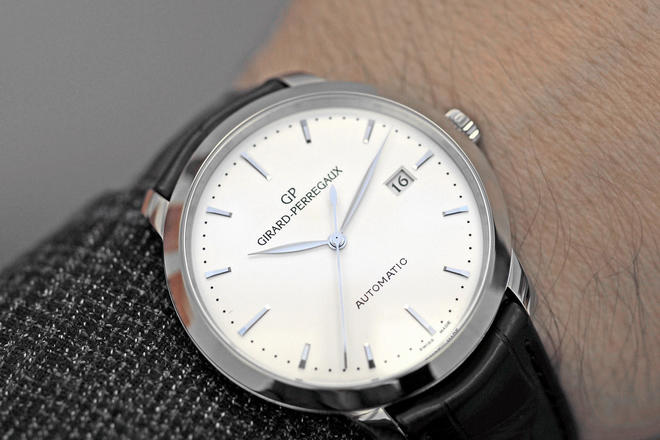
At SIHH, Girard-Perregaux’s Haute Horlogerie collection is going to be enhanced by adding one inspired by its background and its complication: the Girard-Perregaux 1966 Tourbillon with Gold Bridge. Indicating the essence of Girard-Perregaux the watchmaking industry tradition, it will likely be obtainable in an edition of fifty individually-designated pieces.

Within the mid-1800s, Constant Girard-Perregaux produced a watch which was granted an initial-class prize through the Neuchatel Observatory. Its tourbillon movement featured three parallel bridges, to which the barrel, center wheel and tourbillon were aligned. Within this innovative concept, the tourbillon offered not just like a technical and funcational component, but because a design element too. In 1889, the watch manufacturing company received the best accolade: Girard-Perregaux won a gold medal in the Paris Universal Exhibition for his Tourbillon with Three Gold Bridges.
The brand new 1966 Tourbillon With Gold Bridge brings up its illustrious forerunners and pays tribute to tourbillon pocket watches. The “Breguet” Arabic numbers colored around the silvered dial, along with the blued steel leaf-formed hands, are generally obvious references to a period when only pocket watches been around. The clean lines of their 40-millimeter situation disguise a classy design and production process. Its curvature and lugs happen to be carefully fashioned to sit down perfectly around the wrist. The situation-back, closed by 6 screws, is hands-engraved to stimulate the domes of Girard-Perregaux’s tourbillons dating in the 1800s. Each bit bears its very own individual number, also engraved manually consistent with the Brand’s tradition.
The situation houses a Girard-Perregaux 9610 movement composed of 224 components, the refined decoration and architecture which will also be inspired by 1800s pocket tourbillons.
The tourbillon bridge from the new Girard-Perregaux 1966 Tourbillon comes with an unusual shape: referred to as “bassiné”, the 2 arms from the bridge are rounded off. The rounding off process includes filing the finishes from the arms to ensure they are perfectly uniform, providing them with a semi-round shape while retaining the demarcation from the center and also the heels. To complete the operation, the craftsmen use gemstones, buffs, boxwood and gemstone pastes to smooth these to a wonderfully rounded finish. The smallest imperfection could be immediately detected through the human eye alone. This craftsmanship necessitates the greatest degree of skill and concentration.
The fragile tourbillon also demands extreme focus on detail: incredible skill is needed to put together its 72 components, which squeeze into a diameter of a single centimeter. It weighs in at .3 gram – comparable like a swan’s feather. Associated it’s a self-winding system patented through the Manufacture: a little-diameter platinum oscillating weight is located within the space below and round the barrel. This elegant design leaves the movement’s dimensions and architecture intact.